Generative AI for molecular design

Design de novo biomolecules
with fine‑tuned language models

One modular, config-driven pipeline to fine-tune, generate, benchmark and Bayesian-optimize generative models for small molecules, proteins & peptides, and nucleic acids — engineered to run on a 6 GB laptop GPU.

Python 3.9+ PyTorch · Transformers · PEFT LoRA / QLoRA Optuna Bayesian Opt. MIT License

Author: Dr. Sanjay Anbu · Windows · macOS · Linux

What it does

A single modality registry drives everything — add a biomolecule type in a few lines and the entire train → generate → evaluate → optimize flow just works.

🧬

Multi-modality

SMILES / SELFIES molecules, protein & peptide sequences, and DNA/RNA — one framework, one CLI.

🎛️

Fine-tune anything

Full fine-tune, LoRA, or 4-bit QLoRA on any Hugging Face causal LM. Defaults tuned for 6 GB VRAM.

📊

Standard metrics

Validity, uniqueness, novelty and diversity — the field-standard de novo benchmark, reported automatically.

🔭

Bayesian optimization

Optuna (TPE) tunes sampling & training hyperparameters to maximize quality with a small trial budget.

⚙️

Config-driven

One short YAML fully describes a run. Ready-made configs for ProGen2, GPT2-ZINC, ProtGPT2 and more.

💻

Runs on your laptop

Built and documented for an RTX 3000 (6 GB). Cross-platform commands for Windows, macOS & Linux.

Quickstart

Install, run the CPU smoke test to validate your setup, then fine-tune ProGen2 on your GPU.

Linux
macOS
Windows (PowerShell)
# 1. Environment (Python 3.12)
python3.12 -m venv .venv && source .venv/bin/activate

# 2. PyTorch (CPU; for GPU use the cu128 index) + the package
pip install torch
pip install -e ".[chem]"          # adds RDKit + SELFIES

# 3. Offline smoke tests (no network / GPU needed)
denovo-mol pipeline -c configs/mol_flow_smoke.yaml
python scripts/make_tiny_local_model.py
denovo pipeline -c configs/smoke_local.yaml

# 4. Real fine-tune (downloads ProGen2 from Hugging Face)
denovo train    -c configs/progen2_protein.yaml
denovo generate -c configs/progen2_protein.yaml -n 500 -o generated/prot.txt
denovo evaluate -c configs/progen2_protein.yaml -i generated/prot.txt
# 1. Environment (Python 3.12)
python3.12 -m venv .venv && source .venv/bin/activate

# 2. PyTorch (Apple Silicon uses the MPS backend automatically)
pip install torch
pip install -e ".[chem]"

# 3. Offline smoke tests
denovo-mol pipeline -c configs/mol_flow_smoke.yaml
python scripts/closed_loop_demo.py

# 4. Real fine-tune (set train.fp16:false on Mac — use MPS defaults)
denovo train    -c configs/progen2_protein.yaml
# 1. Environment (Python 3.12, PowerShell)
py -3.12 -m venv .venv; .\.venv\Scripts\Activate.ps1

# 2. PyTorch (CPU; GPU = cu128 index + Python 3.12) + the package
pip install torch
pip install -e ".[chem]"

# 3. Offline smoke tests
denovo-mol pipeline -c configs\mol_flow_smoke.yaml
python scripts\make_tiny_local_model.py
denovo pipeline -c configs\smoke_local.yaml

# 4. Real fine-tune (downloads ProGen2 from Hugging Face)
denovo train    -c configs\progen2_protein.yaml

📖 Full platform-by-platform setup, GPU tips and troubleshooting live in RUN.md.
Choosing a model

On a 6 GB GPU, the recommended de novo model is ProGen2-small. The heavyweight foundation models (Evo 2, ESM-3) are best used via NVIDIA NIM / cloud.

ModelModalityParamsRegimeFits 6 GB?
ProGen2-smallProtein / peptide151MFull fine-tuneYes
ProtGPT2Protein738M4-bit QLoRAYes
GPT2-ZINCSmall molecules (SMILES)87MFull fine-tuneYes
ChemGPT-4.7MSmall molecules (SELFIES)4.7MFull fine-tuneYes
GPT2 char-levelDNA / RNA124MFull / LoRAYes
BioMistral-7BBiomedical text7B4-bit QLoRATight
ESM-3 / Evo 2Protein / DNA1.4B–40BCloud / NVIDIA NIMNo

Full feasibility analysis and NVIDIA NIM notes: docs/MODELS.md.

Benchmarks & results

Every generation run is scored on the four standard de novo metrics. The figures below are produced by scripts/benchmark.py and scripts/make_figures.py.

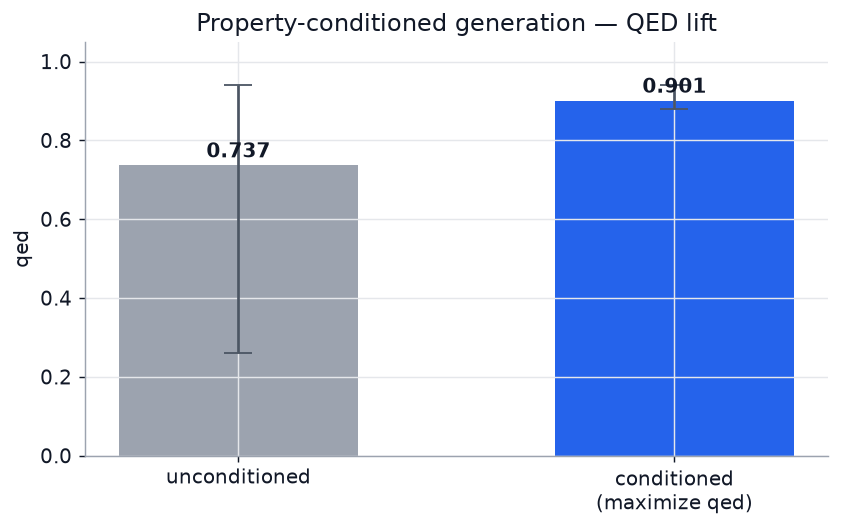
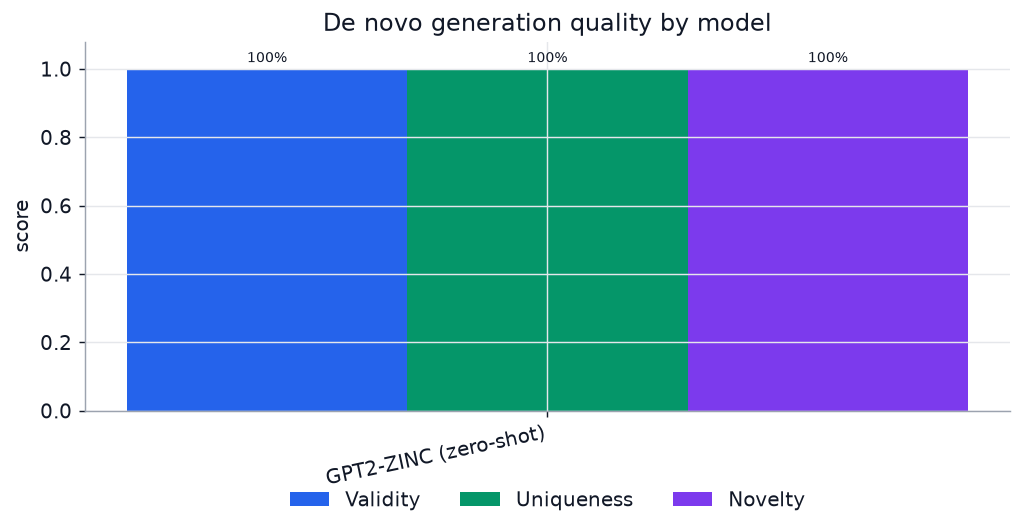
Measured results (GPT2-ZINC 87M, RDKit): de novo — 100% validity / 100% uniqueness / 100% novelty / 0.85 diversity on 1,000 molecules; property conditioning — mean QED 0.74 → 0.90; scaffold constraint — benzene containment steered from 57% to 100%; NVIDIA NIM (MolMIM) — aspirin (QED ≈ 0.55) optimized to QED 0.91 in the cloud. The loss and Bayesian-optimization charts remain illustrative until those runs.

Measured de novo benchmark: validity, uniqueness, novelty
Measured validity / uniqueness / novelty — GPT2-ZINC zero-shot (1,000 molecules).
Property-conditioned generation QED lift
Property-conditioned generation: steering to max QED lifts mean 0.74 → 0.90 (measured).
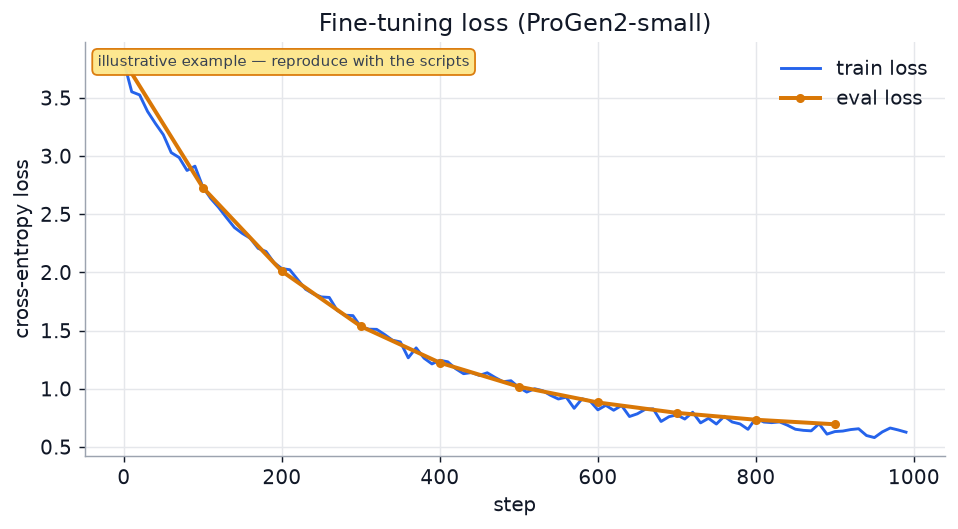
Training loss curve
Fine-tuning train/eval cross-entropy loss (ProGen2-small).

Bayesian optimization

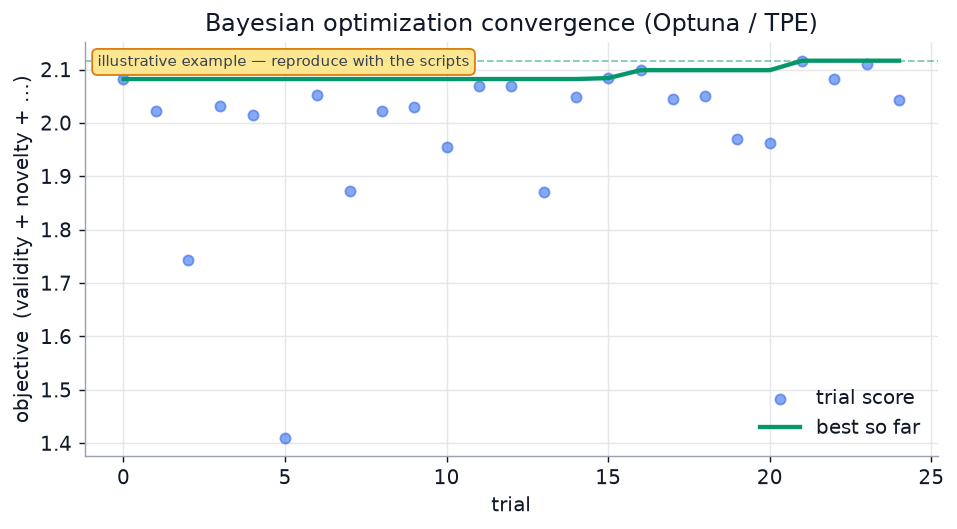
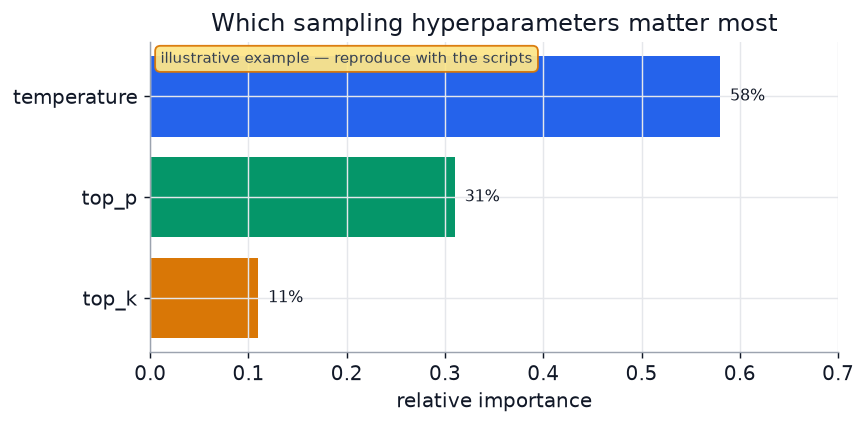
Sampling and training hyperparameters are tuned with Optuna's TPE sampler — a Bayesian method that finds strong settings in far fewer trials than grid or random search.

# Optimize decoding hyperparameters against validity + novelty + diversity
denovo optimize -c configs/progen2_protein.yaml \
    --mode sampling -m outputs/progen2_small --trials 25 \
    -o docs/results/bo_study.json

# Render the graphs below from the study
python scripts/make_figures.py --study docs/results/bo_study.json
Bayesian optimization convergence
Best objective value improving over trials (TPE convergence).
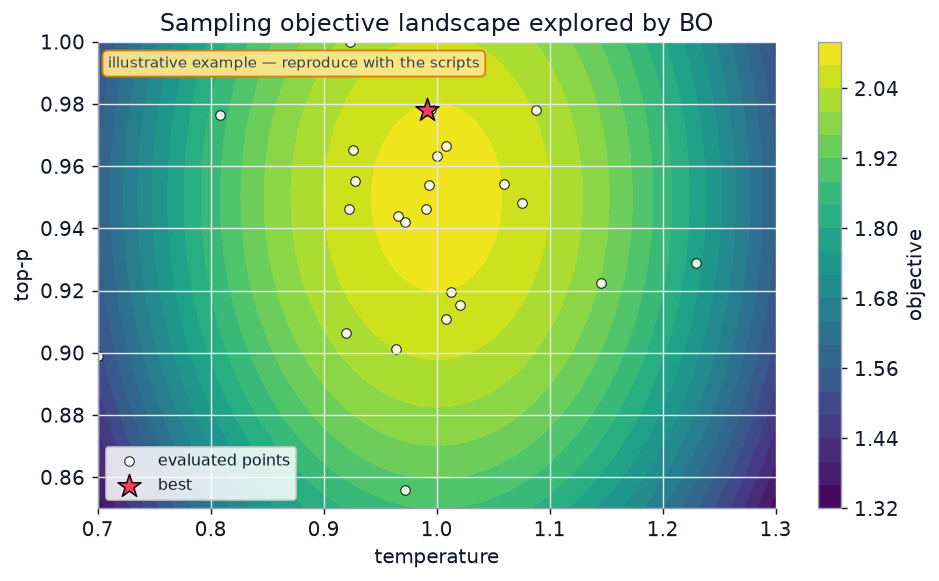
Objective landscape
Objective surface over temperature × top-p, with evaluated points and the optimum.
Hyperparameter importance
Relative importance of each sampling hyperparameter.

Citation

If this project supports your research, please cite it.

@software{sanjay_denovo,
  author  = {Dr. Sanjay Anbu},
  title   = {De-Novo-LLM: Fine-tuning language models for de novo biomolecule generation},
  year    = {2026},
  url     = {https://github.com/sanjaydoc/De-Novo-LLM}
}